
Industrial Data Infrastructure with the AVEVA PI System
Industrial organizations depend on reliable operational data to make informed decisions, improve production visibility, and support digital transformation initiatives. The AVEVA PI System has become the industry standard for collecting, storing, and delivering real-time industrial data across oil & gas, manufacturing, utilities, mining, and other process industries.
At Sunlead Technologies, we help organizations design, upgrade, migrate, and optimize industrial data infrastructure using the AVEVA PI System. From historian migrations and Asset Framework design to cloud integration and enterprise reporting, our engineers support every stage of the industrial data lifecycle.
Whether your organization is planning a PI System upgrade, modernizing historian infrastructure, or building enterprise data architecture, a properly designed PI environment provides the foundation for scalable operational intelligence.
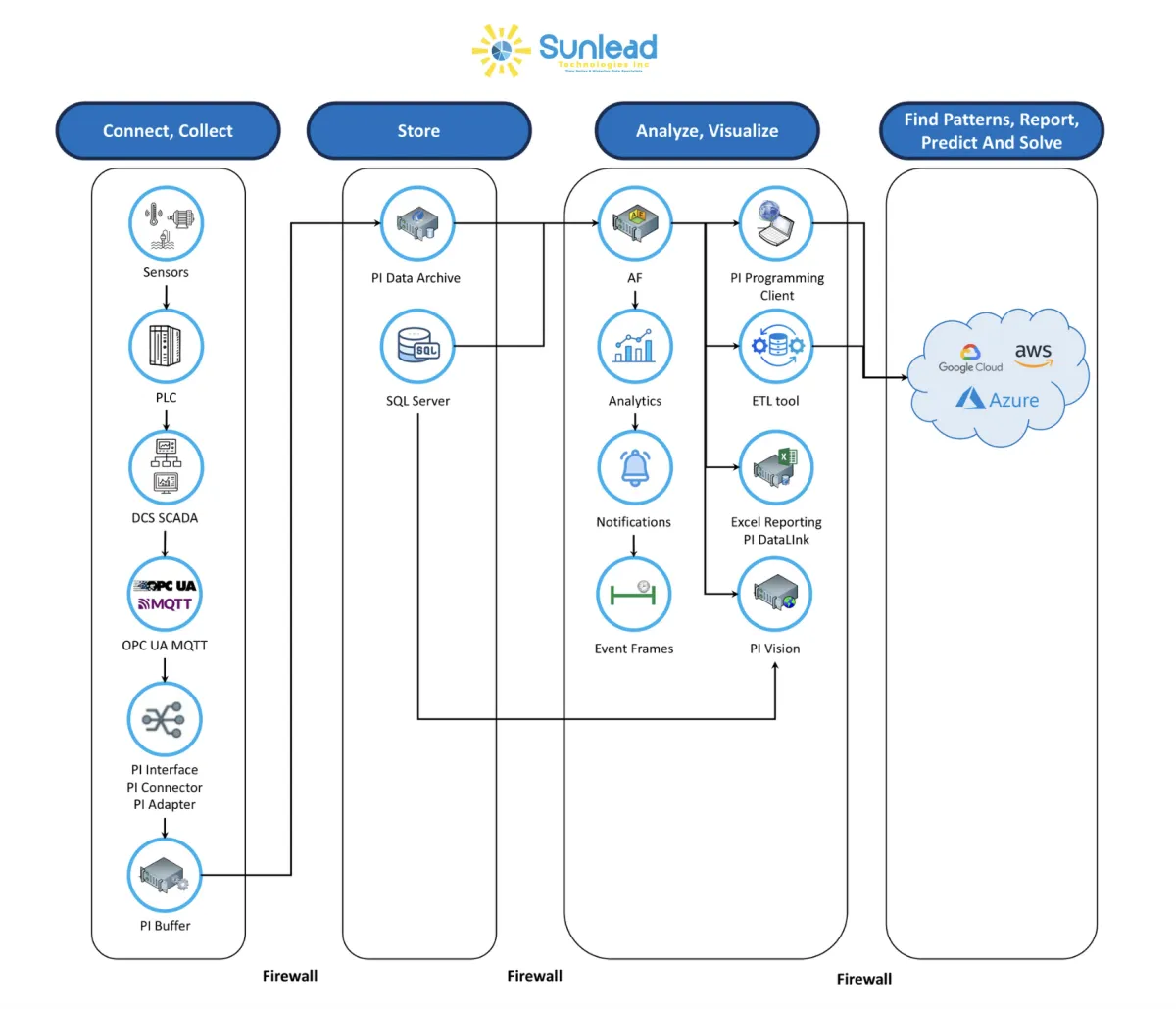
How Industrial Data Moves Through the PI System
Every industrial facility continuously generates operational data from equipment across the plant. PLCs, DCS platforms, SCADA systems, analyzers, sensors, compressors, pumps, and other operational assets all produce valuable information that can improve reliability, maintenance planning, production optimization, and operational visibility.
The AVEVA PI System acts as the central industrial data infrastructure by collecting information from these systems, organizing it into meaningful asset models, and delivering trusted operational data to engineers, operators, maintenance teams, and business users.
A typical PI System architecture includes three primary stages:
Collect
Store & Contextualize
Deliver
Each stage plays an important role in transforming raw operational data into actionable industrial intelligence.
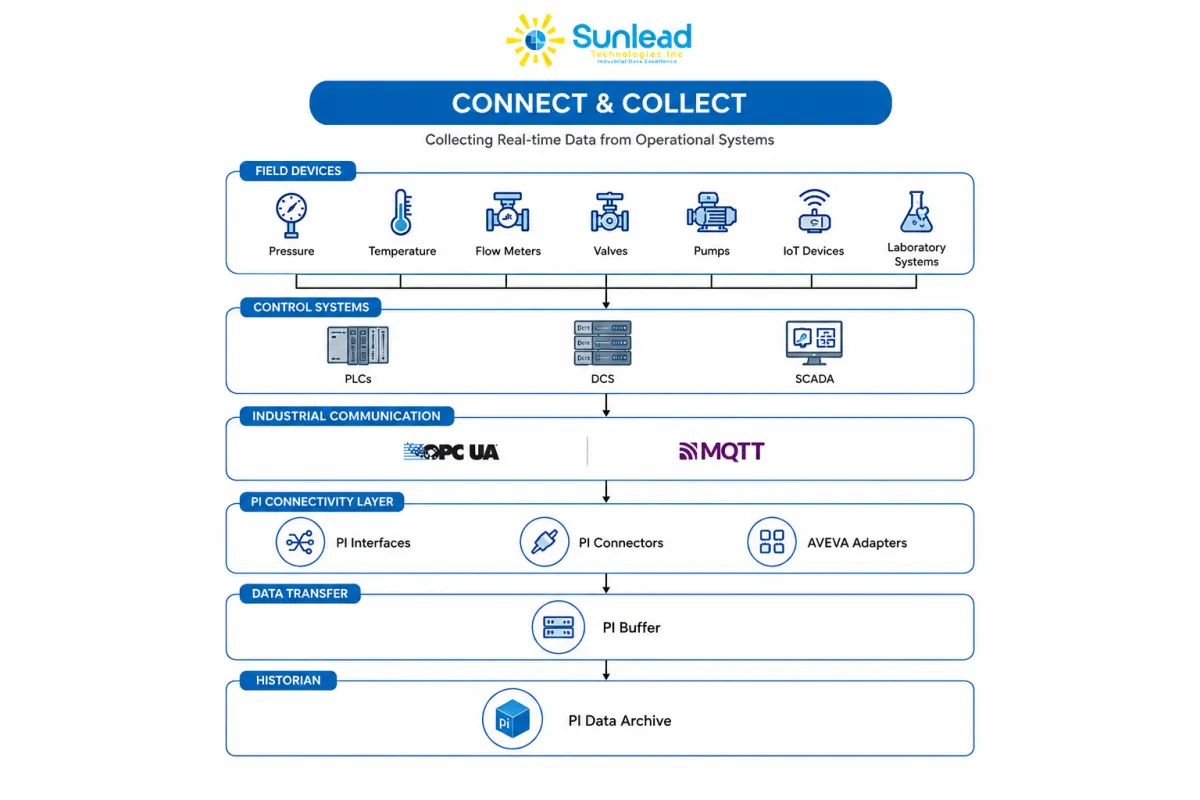
Collect Industrial Data from Operational Systems
The first step in any industrial data infrastructure is reliable data collection.
The PI System supports hundreds of industrial communication methods through PI Interfaces, PI Connectors, OPC technologies, MQTT, Modbus, DCS platforms, SCADA systems, PLCs, laboratory systems, and many other industrial applications.
Continuous, high-quality data collection is essential because downstream analytics, dashboards, reporting, and AI initiatives all depend on accurate historian data.
During implementation projects, Sunlead Technologies validates communication paths, tag quality, interface health, and historian connectivity to ensure reliable long-term data collection across production environments.
Common industrial data sources include:
- PLCs
- DCS
- SCADA
- OPC Servers
- Modbus Devices
- Remote Field Equipment
- Industrial IoT Devices
- Laboratory Systems
- Enterprise Applications
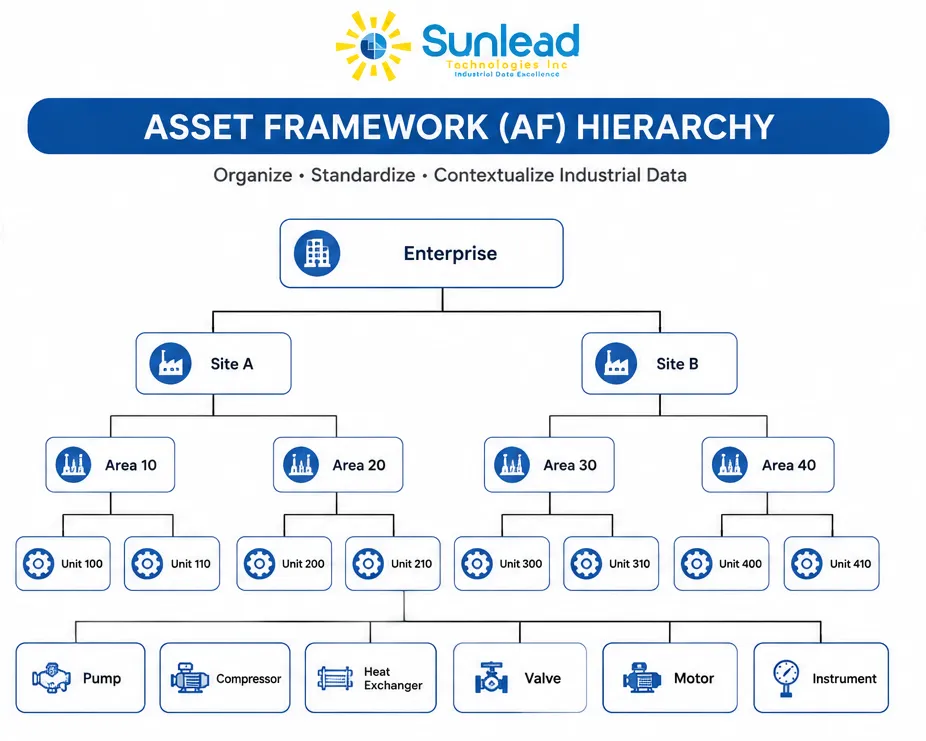
Store and Contextualize Operational Data
Once operational data is collected, it must be organized into a structure that supports long-term scalability.
The PI Data Archive stores high-frequency time-series data using efficient compression while maintaining fast retrieval performance for years of operational history.
To make this data meaningful, the Asset Framework (AF) organizes information around physical equipment, production assets, facilities, and business processes. Instead of viewing thousands of individual tags, engineers can work with structured asset models that are easier to maintain, standardize, and expand across multiple facilities.
Additional PI System capabilities such as Asset Analytics, Event Frames, and Notifications help transform raw historian data into operational intelligence by identifying equipment conditions, tracking events, calculating KPIs, and notifying users when important operational conditions occur.
A well-designed Asset Framework is one of the most important investments an organization can make. Proper AF governance improves reporting consistency, simplifies future expansion, and reduces long-term maintenance costs.
Sunlead Technologies helps organizations redesign poorly structured Asset Framework databases, establish governance standards, and build scalable architectures that support future growth.
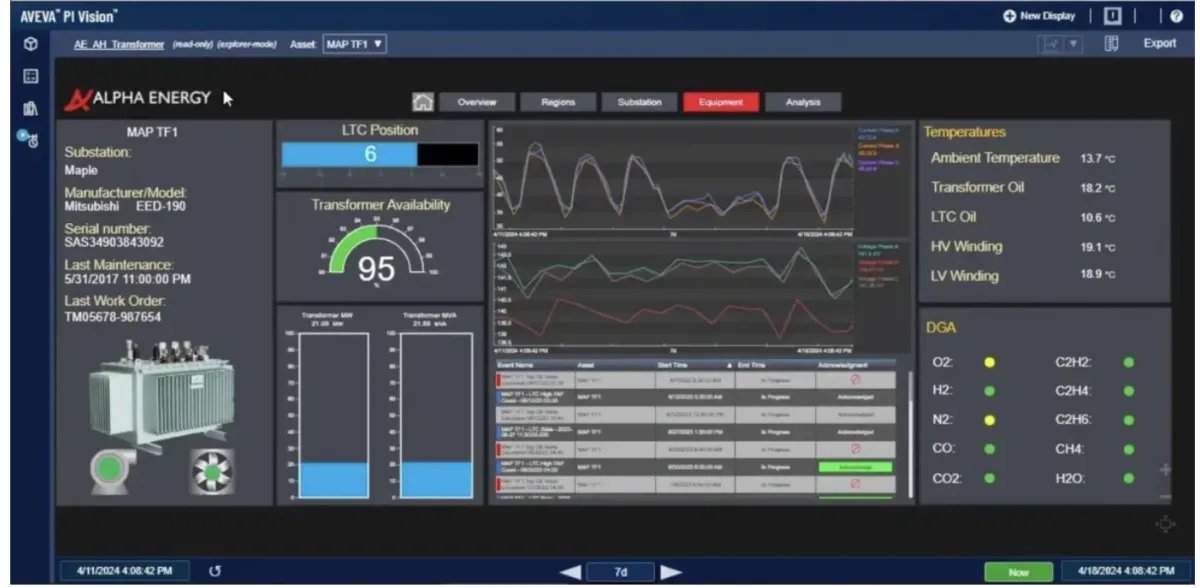
Deliver Industrial Intelligence Across the Enterprise
Collecting data is only valuable if people can use it.
The PI System delivers operational information through visualization tools, reporting platforms, cloud services, APIs, and enterprise integrations that make industrial data accessible across the organization.
Engineers commonly use PI Vision dashboards to monitor production, equipment health, process performance, and key operational KPIs in real time. Maintenance teams use historian data to investigate equipment failures, while operations teams rely on dashboards to improve plant visibility and decision-making.
The PI System also integrates with Microsoft Excel, Power BI, Azure Data Factory, enterprise data warehouses, SAP, and many third-party applications, allowing industrial data to support business intelligence, reporting, advanced analytics, and AI initiatives.
Rather than existing as an isolated historian, the PI System becomes the operational data foundation for enterprise digital transformation.
Typical Industrial Data Architecture
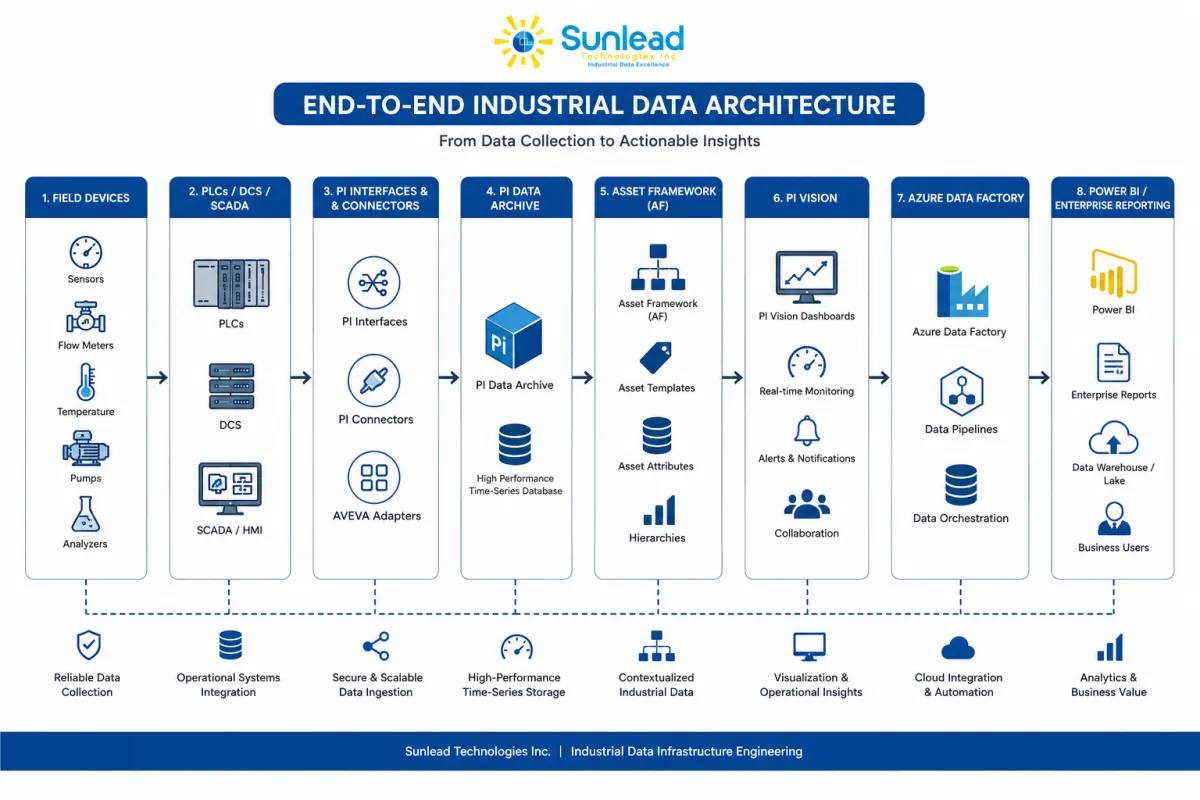
Although every facility has unique requirements, most industrial data infrastructures follow a similar architecture.
Operational data flows from field devices into PLCs, DCS, or SCADA systems before entering the PI System through Interfaces or Connectors. The PI Data Archive stores historical information while Asset Framework organizes operational assets into standardized models.
From there, operational data becomes available to PI Vision dashboards, cloud platforms, enterprise reporting tools, analytics applications, and business systems.
A properly designed architecture ensures data integrity, scalability, and long-term maintainability while supporting future modernization initiatives such as cloud integration, predictive analytics, and enterprise AI.
Common PI System Challenges
Many organizations invest in the PI System but struggle to achieve its full value because the underlying architecture was never designed for long-term scalability.
Some of the most common challenges include:
- Poorly designed Asset Framework hierarchies
- Inconsistent naming standards
- Duplicate or orphaned tags
- Historian performance issues
- Broken interface communications
- Failed PI System upgrades
- Difficult historian migrations
- Incomplete validation after infrastructure changes
- Cloud integration challenges
- Dashboards built on unreliable data
Addressing these issues requires more than software knowledge—it requires practical engineering experience working with industrial data infrastructure in live production environments.
How Sunlead Technologies Supports PI System Projects
Sunlead Technologies specializes in industrial data infrastructure engineering for oil & gas organizations across North America.
Our services include:
- PI System upgrades
- PI Server migrations
- Historian modernization
- Asset Framework architecture and governance
- PI Vision implementation
- Industrial data validation
- Azure Data Factory integration
- Enterprise historian architecture
- Industrial reporting enablement
- Technical architecture reviews
Every engagement is focused on building reliable, scalable industrial data systems that support operations today while preparing organizations for future digital transformation initiatives.
Contact Details
+1 (587) 327-7514
Calgary.Alberta


Copyright 2026. Sunlead Technologies Inc. All rights reserved.